Average Reviews:

(More customer reviews)At first I was hesitant to buy the PC PIN100. The reviews were the core of my concern. Does it leave a dent in the work? Will it quickly malfunction? Is the pin visible? Is it a quality tool, or a piece of junk?
I took it out of the carrying case, and the clear plastic wrap, and immediately put 5 drops of the oil that comes in the kit, in the air nozzle. I wanted to ward off any jamming problems.
Upon loading the nails, I noticed that there were multiple arrows printed on the side of the nail strip. That way you would load them in the right direction. If you ignored the arrows, and loaded them upside down, which is possible considering the small size of the pins, the sharp, fine, thin tip would be up, to do battle with the hammer coming down. Certainly, it would veer off to one side, thereby freezing the hammer and pin. In addition that kind of action could score the shaft, and that would lead to other possible misfires. People reporting problems with jams could have done just that.
The top of the pin has a blunt-flat end on it, and the business end is sharp. Since they are so tiny, if you don't notice the arrows on the side, it is easy to load them upside down.
These pins are not serrated, or ring shanked, but rather smooth on the sides. That way they don't receive resistance on the way down. Important considering their fine size.
I was able to take the 3/4" pins, that come with the kit, and drive several into a 3/4" piece of oak, without any problems whatsoever. I first tested it out on a piece of scrap pine. Since I loaded the nailer with oil, it came out of the nose quite readily, which made a slight black mark where the pin went into the wood. Since the pine is very light, it showed. It was worth it, I wanted to break it in properly. After about 20 pins the oil cleared, I then went onto the oak, and it left a pin without any blemish. All in all with all of my testing, the pin nailer never misfired, or even hinted, at a misfire even once. I put it to the test with firing nails, as fast as I could squeeze the trigger, and never a problem or a glitch. You can fire a lot of nails very quickly with this tool.
It doesn't have the safety nose that requires plunging like the rest of the Porter Cable finish nailer line. That way you can get into finely cramped quarters, and get the pin in at your desired angle. What PC did, was put two levers on the handle, one is a safety release, and the other one is the firing trigger. It is well engineered that way, and is easy and intuitive to use.
How about the pin, does it show? On the first test pieces, with 5 drops of break in oil, it showed on the pine. After blowing it out with 20 pins, the oil deposits stopped, and all you saw was the pin hole. Does the pin hole become invisible by wiping water on the wood? I am getting critical here, but yes it does show. I was dreaming of the wood swelling, and making the pin hole completely invisible. That didn't happen in the pine and oak I tested it in. BUT the pin hole is so small, that all but the most critical customers will object to it. I have to admit that it is so tiny, that it couldn't be any smaller without disappearing altogether. Miniscule is the appropriate word here. It makes an 18 gauge finish nail look like a crater in comparison. For light colored wood it is barely visible, and for medium to dark woods it will disappear altogether. So if you are looking to attach really fine work, like 1/4" quarter round mldgs, this is just what the doctor ordered.
I tried to be critical of the impression if any the head would leave in the work. When working with oak, even at the highest pressures, it did not leave a mark. Pine on the other hand, required a gentle touch. If you pressed down on the head while firing, it left a tiny impression. If you laid the head gently onto the surface, and fired, it left no impression whatsoever. Considering that pine is so soft, that you can leave an impression in it with your finger nail, I laid to rest any concerns about dimples in the wood.
The air pressure range prescribed by PC is 60 to 100 PSI. It is advisable to stay within that range, whereas excessive pressures can cause problems. I imagine the firing apparatus is designed to ideally work within those ranges, and subjecting it to excessive pressure is reason for concern. I tweaked my regulator on the wall to 105 pounds, which would give me 100 or less at the gun, and it fired well without any difference in the head impression on the work.
So what does all of this mean? Simply put, I love this tool. It does the job beautifully, appears to do so without any suggestion of malfunctioning. I have the Porter Cable 16 gauge, and the 18 gauge both in the BN 125A and the 200A, and this makes my fourth PC finish level nailer, and not one of them has given me any problems. (They can misfire if you run them dry. I guess that is why PC always includes a squeeze bottle of oil with every nailer.)
This is a keeper. I bought the other size pin nails as well. They come in 1/2", 5/8", 3/4", and 1 inch. It comes with the 3/4", so I picked up the other sizes.
I am looking forward to using the PC PIN100 in doing the fine work. You can spend a lot of time, and get a large project to really look fine, but the small details can make the difference of looking like artwork, or a signature of a less skilled practitioner. This tool will make you an artist, on the detail work. Highly recommended.
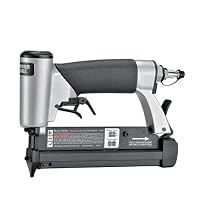
Click Here to see more reviews about: Porter-Cable PIN100 1/2-Inch to 1-Inch 23-Gauge Pin Nailer
The Porter-Cable PIN100 1/2-Inch to 1-Inch 23-Gauge Pin Nailer takes care of all of your finishing projects, such as crown molding and other molding, and does it quickly and efficiently. It uses a dual trigger feature to fire the 23-gauge micro pin nails from the 170 pin bottom load magazine. This smart pin nailer even recognizes the length of the nail and automatically adjusts accordingly. The rubber comfort grip ensures hours of easy operation.
 Get 46% OFF
Click here for more information about Porter-Cable PIN100 1/2-Inch to 1-Inch 23-Gauge Pin Nailer

No comments:
Post a Comment